




Bicycle pilgrimage route between Rabenau and Dippoldiswalde
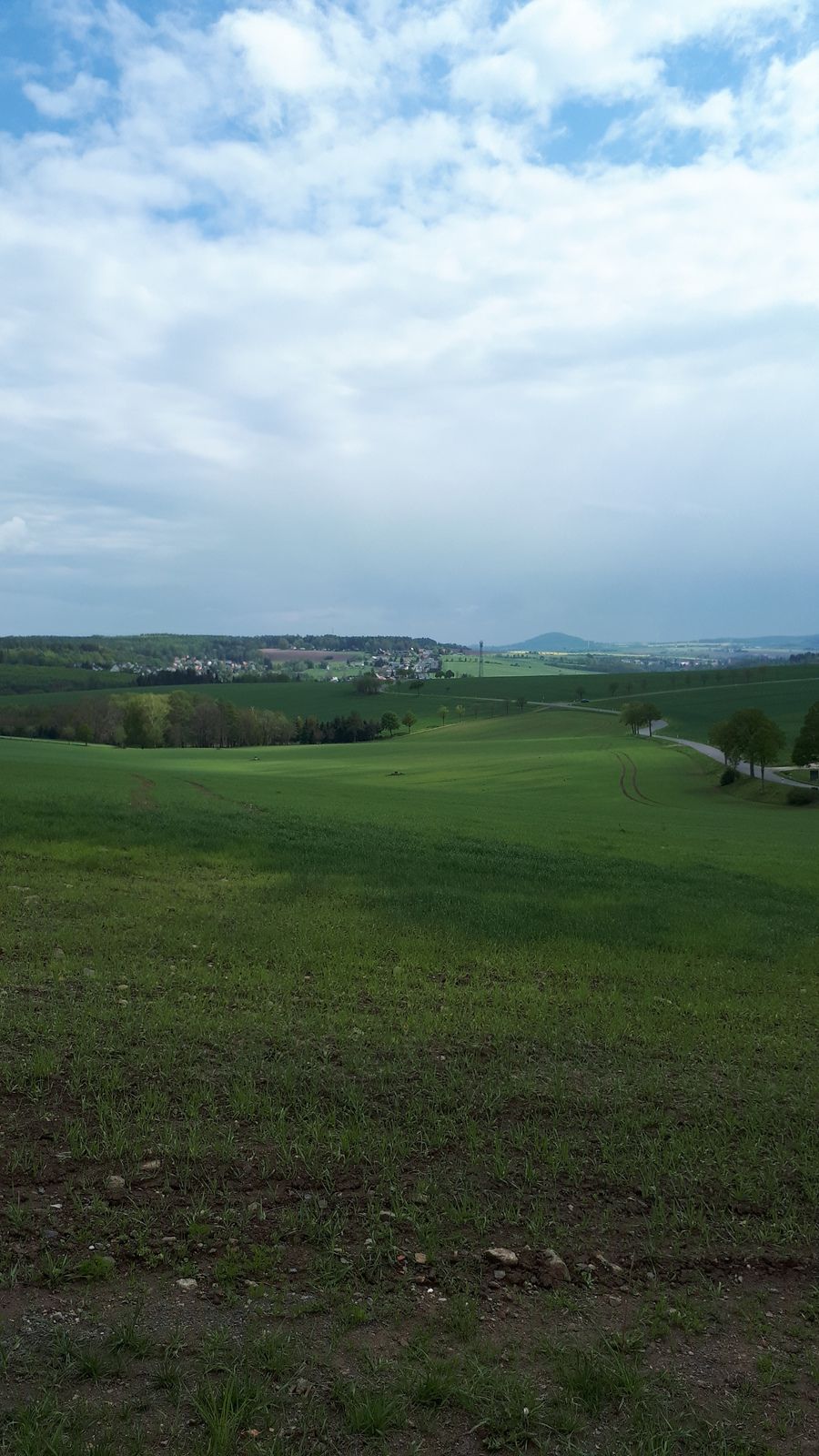
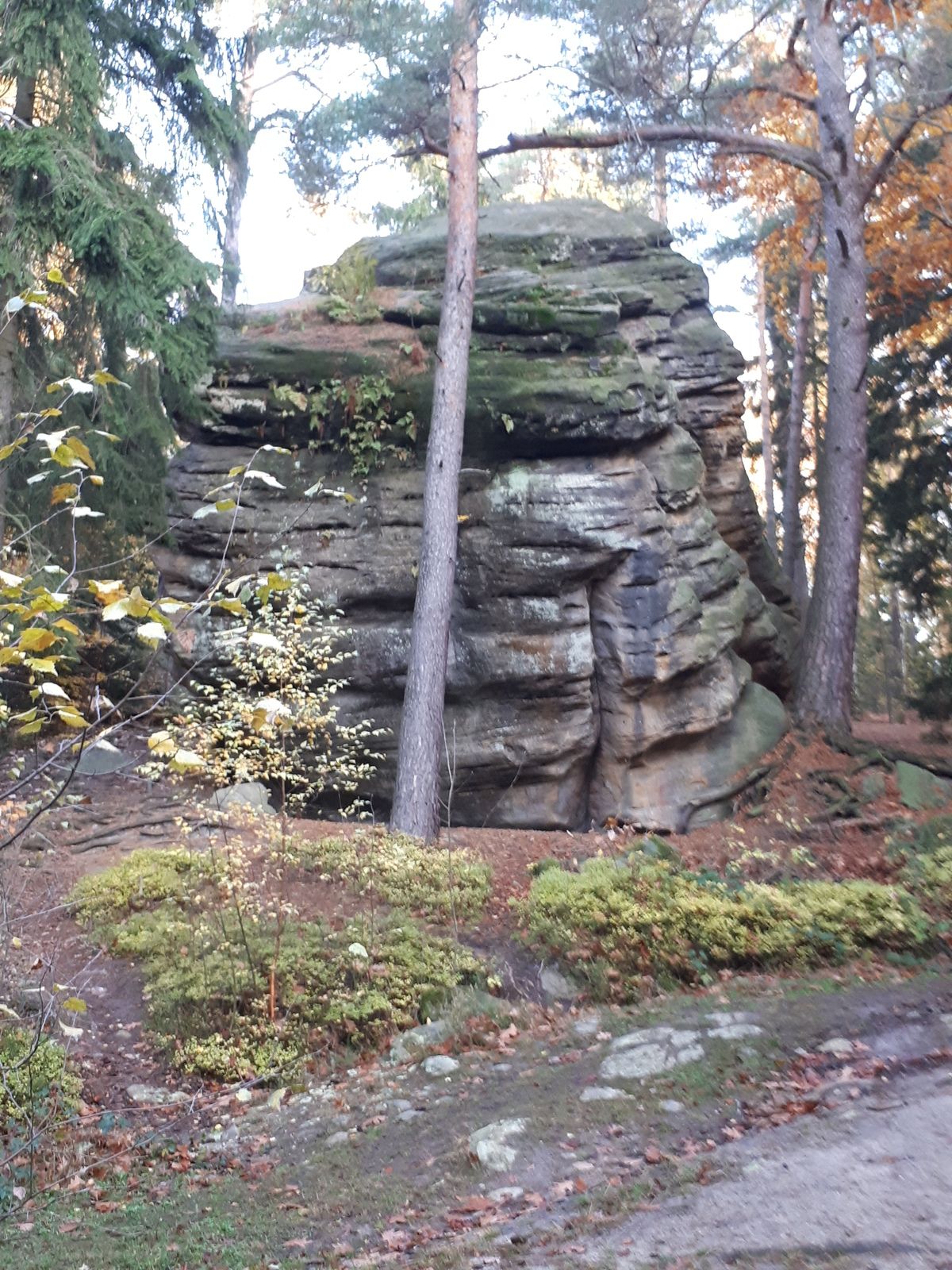
This circular route takes you through charming countryside with magnificent views, forests, past meadows, fields and along the atonement crosses, ruins, prayer pillars, churches, wayside monuments and...
This circular route takes you through charming countryside with magnificent views, forests, past meadows, fields and along the atonement crosses, ruins, prayer pillars, churches, wayside monuments and memorials at the foot of the Osterzgebirge. Each one has its own history and stories to tell, which in turn are linked to the history of our lives and that of our region. Above all, however, spiritual and intellectual impulses, our "food for thought", are intended to inspire you to reflect along the way. We want to get you and something in you moving.
The circular route includes the towns of Rabenau, Oelsa, Seifersdorf and Dippoldiswalde and, thanks to the good public transport connections (bus-RVSOE and Weißeritztalbahn), can also be easily completed in stages or started at any point along the route.

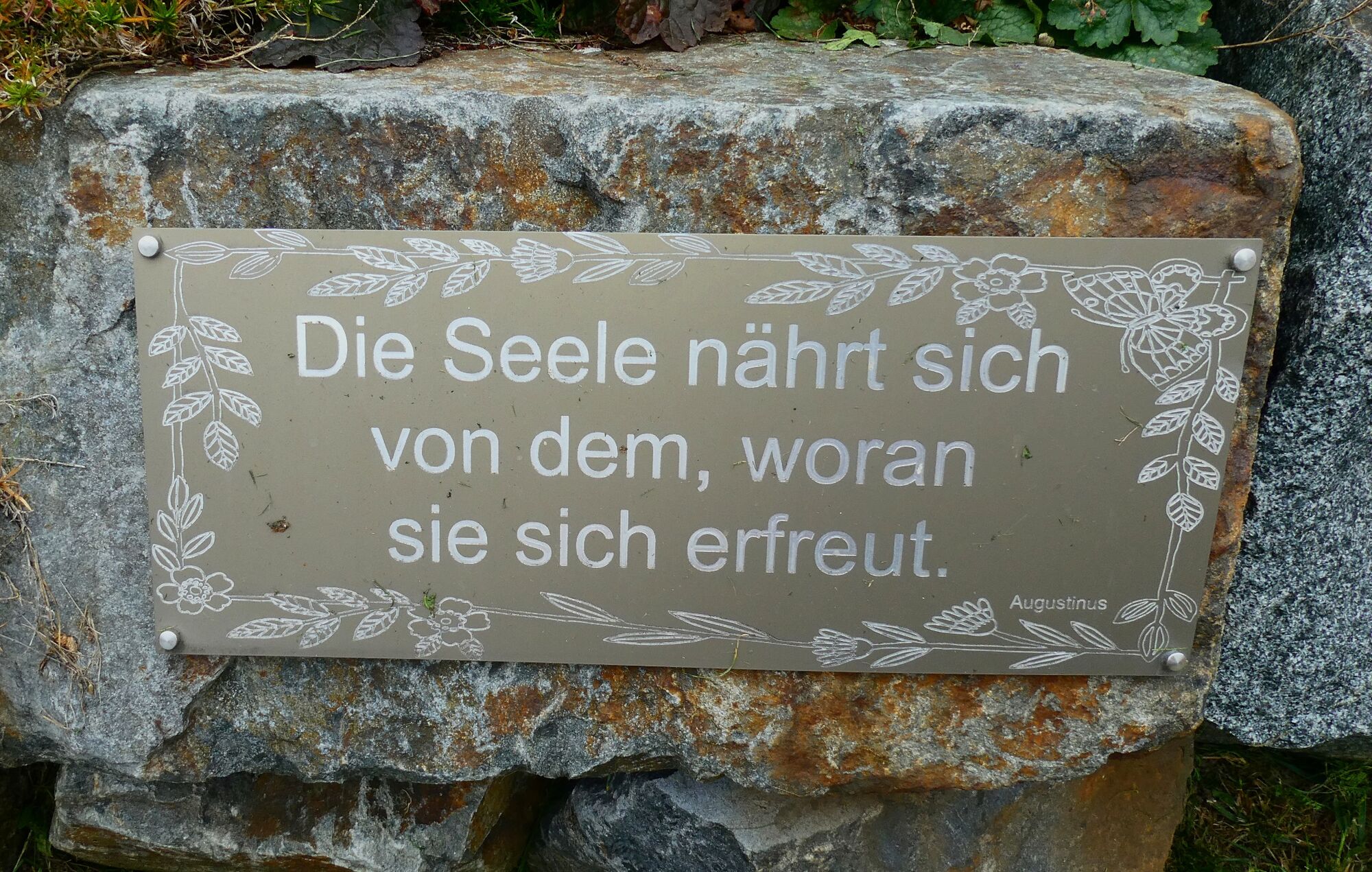
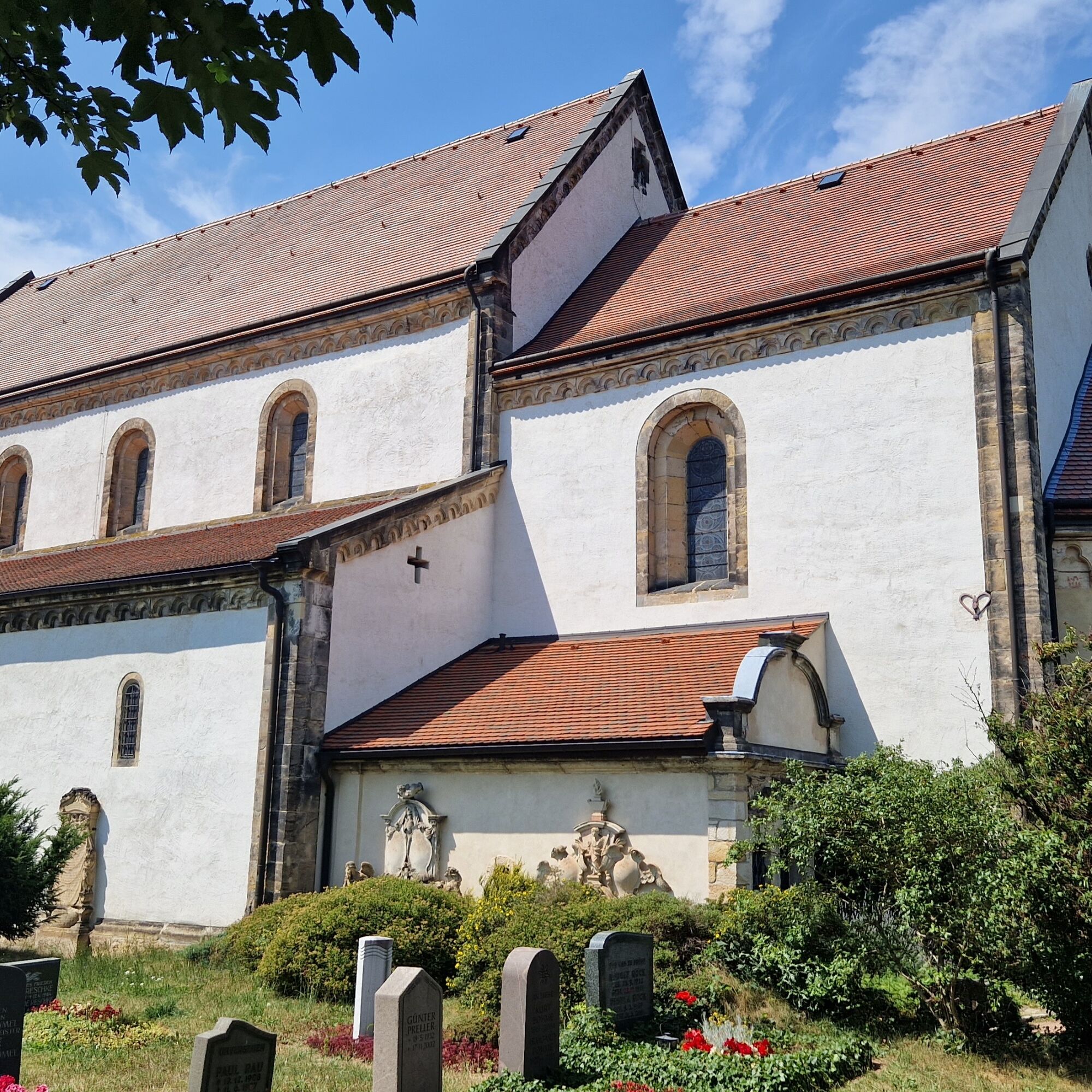


Start at the 1) Church of St. Egidien Rabenau (parking lot at the market or behind the town hall opposite - for a fee). A chapel stood here around 1230. It was dedicated to St. Egidius. The church and parish have belonged to the Evangelical Lutheran Church of Saxony since 1539. The name has been St. Egidien Church ever since. A wooden sculpture by the Rabenau sculptor Olaf Klepzig stands in front of the church. Egidius came from a wealthy merchant family in Greece. He then lived as a monk in the south of France. He founded and ran a monastery there. He was a popular saint in Europe. He was prayed to in times of illness and bad weather. It is said that a doe fed him with her milk in the solitude and wilderness. She helped him to survive.
Something to think about on the road: Christ says: "I am the bread of life." (Gospel of John chapter 6 verse 48) What feeds my soul and satisfies my hunger for life? - And what do I give to satisfy the hunger of others?
Further route: Pass the rectory and turn left downhill on Lindenstraße until you reach the Spechtritz junction, turn right onto Dippoldiswalder Straße and follow it to the left as a pedestrian and cycle path.- and cycle path and follow it straight uphill, past the Götzenbusch nature monument, turn right at the old sandstone pillar after reaching Seifersdorfer Straße and follow it uphill to the Martersäule sign:
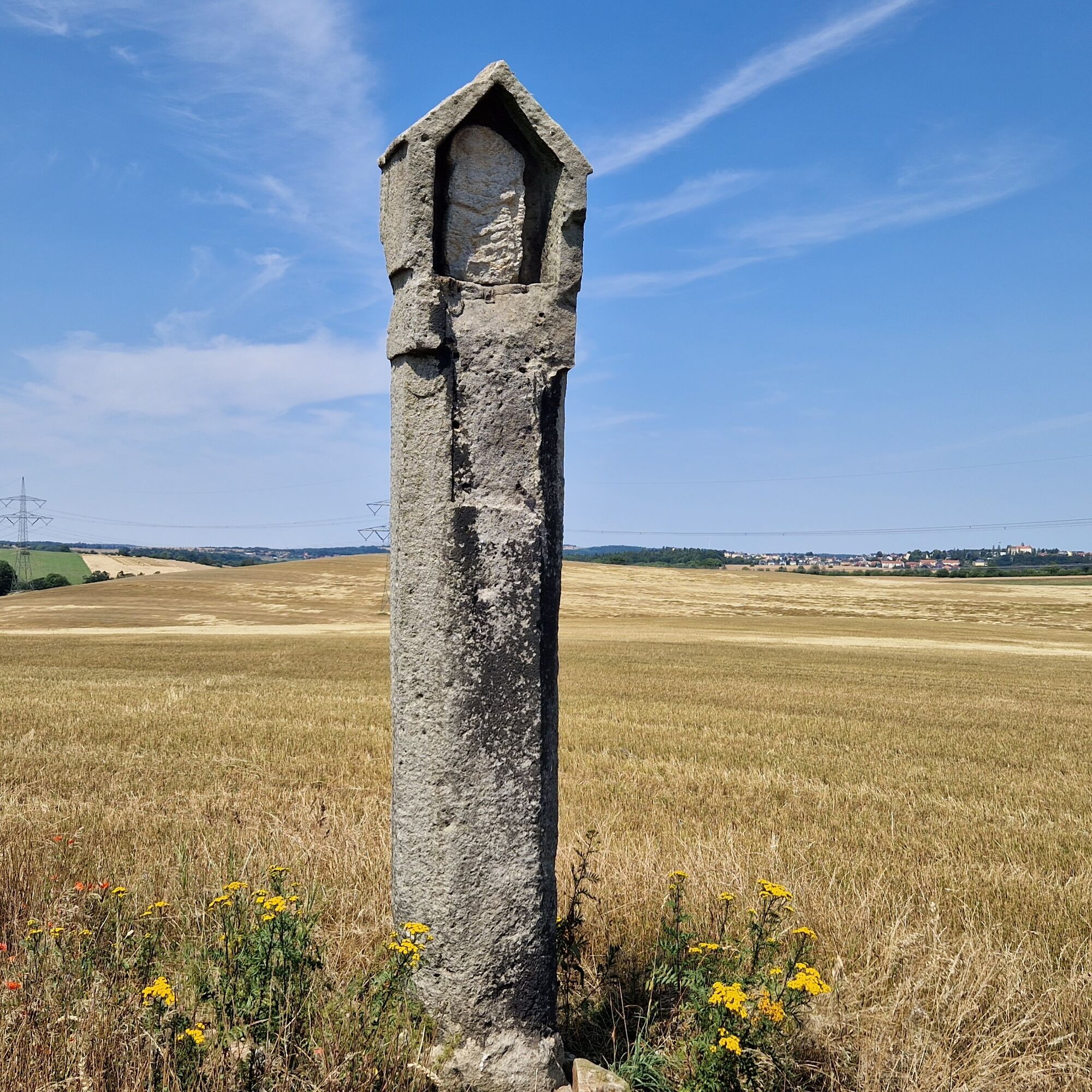
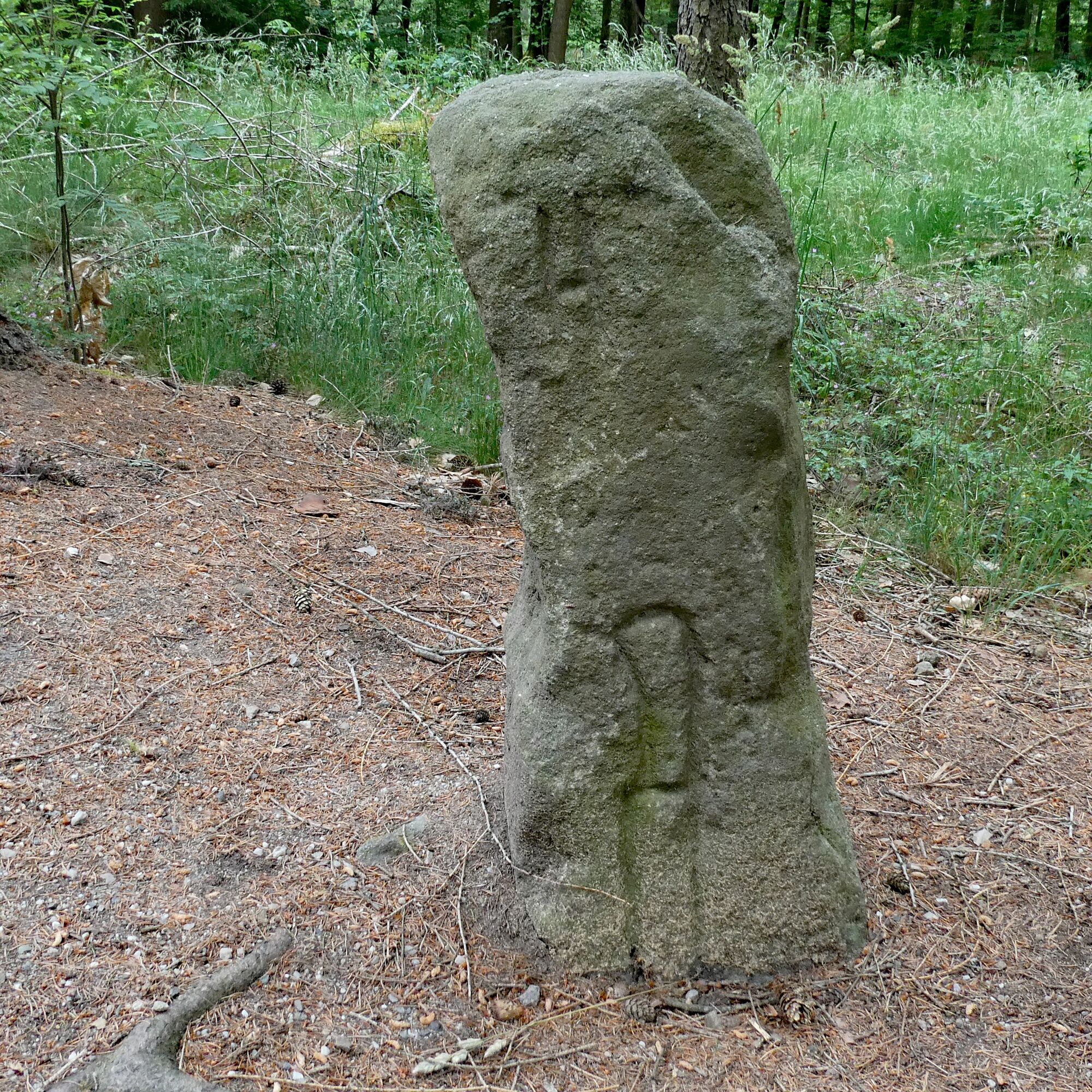
2) Prayer column (Martersäule) Seifersdorfer Straße
This sandstone pillar is probably from the 15th century. The picture shows Mary with the baby Jesus. Older descriptions mention a crucifix in the barred niche. It was stolen in 1917, replaced in forged form in 1930 and is currently in the German Chairmaking Museum in Rabenau. At the beginning of the 20th century, two plaques were placed under the niche with the words: Praise be to Jesus Christ!
Something to think about when you are out and about: pause and look at what others do for me. As a human being, I am one among others. I cannot do without others. And neither can others without me. Jesus lived God's human side. He showed how to be philanthropic. God's blessing for your future journey!
Attention! This can only be visited when the fields have been harvested or in winter.
Further route: follow the road to Seifersdorf, Seifersdorf church (town center)
3) Seifersdorf church
The church was first mentioned in a document in 1312. Late Gothic frescoes from the 14th and 15th centuries on the nave walls are remarkable. A fresco next to the pulpit depicts Jesus on the cross. On the first gallery you can see Mary breastfeeding. The baptismal font is decorated with Romanesque ornaments. The winged altar was made in 1518 by the Dippoldiswald painter and carver Mol-Jurge, among others. The figure of St. Nicholas forms the centerpiece. Next to it we find St. John the Evangelist and St. James the Apostle. The wings depict scenes of Jesus' birth or the death of saints and martyrs.
Something to think about when you are out and about: birth and death are themes that we encounter again and again in churches. Arriving in this world and saying goodbye to this life. Christians say that God became man in Jesus Christ. However, the death of Jesus does not mean that God is now dead. Christians believe that life is stronger than all death and everything that can and wants to make us dead. They speak of rising (up).
-Why did I come into this world? What do I want for my farewell from this life?
Further route: After visiting the church, return to Bergstraße and turn diagonally opposite the fire station onto Kirchweg, follow this to Paulsdorf past Seifen, at the T-junction (not the junction for the nursery) you will find the wayside shrine on the right on Thomas-Müntzer-Straße.
4) Wayside shrine with four reliefs (Paulsdorf)
The sandstone pillar shows the crucified Christ with his mother Mary and the favorite disciple John. Christ prays on the Mount of Olives. Christ carries his cross and three people (possibly the crucified Christ with two co-crucified people).
Something to think about on the way: the way to the cruel death on the cross is shown again and again in church art. In the Roman Empire, crucifixion was the death penalty for political opponents and criminals. The cross later became a symbol of the Christian faith. It stands for the burden and suffering of this world, but also for freedom and the belief in a perfect world. - Carrying your own cross. Christ is asked to do so. What burden rests on my shoulders? What am I carrying around with me?
Further route: The path leads to the left to the crossroads and at the end of the bridge railing at the fence on the other side of Talsperrenstraße is
5) the Paulsdorf wayside shrine
The sandstone pillar shows the crucified Christ with his mother Mary and Mary Magdalene. Jesus had a very close relationship with her. She was one of the few women who walked with Jesus and did not give up hope in God's world after his death.
Food for thought on the road: women accompanied Jesus on his last journey. They were the first to discover that death is not the end. They carried on with what they had heard and learned from Jesus. From whom have I learned something that I continue and pass on? How do I keep alive what others have exemplified?
Further route: From here, continue left to the dam wall, cross it and continue uphill on the road through Malter to the Panoramaweg junction on the right.
6) Tartar grave
In memory of Mustapha Sulkowicz, prime lieutenant under the royal Polish and electoral Saxon laudable colonels of Schiebelchen Pulkelanen, who was shot in an attack near Reichstädt on July 1, 1762. Because he was a Muslim, he was not buried in the cemetery, but here according to so-called Tatar custom.
Something to think about when you are out and about: remembering soldiers who have died in wars. Many are not given a final resting place in their country of origin. A person's dignity endures beyond death. Memorials and gravestones like this remind us of this and of the warning: Never again death by military force! - Peace work - what am I doing for it?
Further route: Back to the hiking trail, turn right there and continue for about 100 m to Rabenauer Straße, cross it and turn left at the next street (Nikolai-Ostrowski-Straße), follow it to two sports grounds and take the path on the right.Turn right (yellow line) between them and cycle to the next street, turn left and then right onto Heideweg against the one-way street (please dismount and push your bike) and follow this to the next street.
7) St. Konrad Catholic Church
The church was consecrated on 13.09.1959. The name of the church comes from the patron saint Brother Konrad von Parzham. He was a porter in a monastery for forty-one years. He got up early in the morning and could only rest after midnight mass. Brother Konrad was patient, modest and gentle. He responded to the wishes of pilgrims, beggars and vendors with calm and sensitivity.
To think about on the road: What recurring tasks accompany my everyday life? Do they help me to become patient, sensitive and calm?
Further route:From this church, continue a little further and turn right into Floraweg, which you follow until you reach Rabenauer Straße, cross the road and continue left, in the bend there is an old sandstone pillar, turn right at this pillar and follow the road.ule, turn right at this and continue to the next T-junction, turn left again and you have reached the main road again, cross it and you have reached your next destination, Rosenpark, where you will find the
8) Memorial column in the form of a prayer column with embedded metal plaque for Gabriel Friedrich
Two-part sandstone base, above which is a pointed sandstone stele with an ogival metal plaque. This and another in the lower part of the plinth tell the story of G. F.: On September 4, 1632, not far from here, the mayor Gabriel Friedrich von Dippoldiswalde was cut down by Croats as he led the citizens of this town in their defense against the invading enemy.
Something to think about when you are out and about: people take responsibility for others. Sometimes they protect others and risk their own lives in doing so. Where do I raise my voice for others when they are threatened or suffer injustice? - Do we appreciate what today's mayors do for the people in our towns and cities?
Further route: From Rosenpark, take the one-way street that turns left at the Körner-Eiche natural monument and take the left-hand path to the town wall, where the wayside shrine is located.
9) Column of prayer for the washing of the feet
The Gothic sandstone column originally stood in Niedertorstraße in the Scheunenviertel quarter outside the city wall, at the junction of the old Dresdner Marktsteig, and was moved to its current location in July 1935. It was given a niche painting by Hedi von Eckardstein in oil on copper showing a praying miner. At his feet was the psalm "Praise the Lord daily. God lays a burden on us, but he also helps us" (Psalm 68:20). The copper plaque is stored in the museum's archive. In 1994, the pillar was restored and since then has shown Christ washing the disciples' feet (Gospel of John chapter 13).
Something to think about on the way: "God lays a burden on us, but he also helps us." Could we make this psalm our own?
"Only where you have walked have you really been."
(Johann Wolfgang von Goethe)
Further route: Take the road to the right and reach the market, cross it and walk between the town hall and the Löwenapotheke pharmacy through the old gate to the
10) Town church of St. Marien and Laurentius
We see a Gothic hall church, which was re-consecrated in its current form in 1638. The interior is very colorful, especially with floral patterns. The ceiling painting in the chancel shows Christ in the middle, surrounded by the apostles, evangelists and many Old Testament prophets.
To think about on the way: people who belong to me from my family, my circle of friends, the neighborhood and other contexts. What do we say to each other? What do we share with each other? How valuable are these relationships to me?
10a) Prayer pillar Christ on the cross with Mary and John on the church forecourt
The original location of the pillar was on Bahnhofstrasse in the direction of Freiberg. Travelers leaving the city in this direction had the opportunity to pray for divine assistance for their journey. The original cube-shaped capital, which was restored in 2000, shows three reliefs: Christ on the cross with Mary and John, a soldier with a bound Christ and two figures.
10b) "Snake cube" sculpture on the church forecourt
The sculpture was made in 2000 by the sculptor Friedemann Döhner. The inscription on the ribbon reads: "fas et nefasambulant pene passu pari" ("The right and the wrong/ Right and wrong walk in lockstep.").
10c) Luther memorial in front of the church
Figure of the reformer Martin Luther on a 2.50 m high sandstone plinth. Luther is holding a Bible in his hand. The inscription on the plinth reads: "A strong fortress is our God", sculptor: Ernst Wilhelm Paul (1856-1931), architect: Oppermann.
Further route:After visiting the church of the Luther monument and the bells, go straight on for a short distance and then turn right and keep heading towards the train station (you have a great view of the castle from the road), at the crossroads with four roads you will see the yellow road sign on the other side of the road.turn left into the street Am Mühlgraben, here you will see the hiking sign for the "Heiliger Weg" pilgrimage route, which leads from Bohemia/Czech Republic to Meissen.
11) St. Nikolai Church
The church was built in the first half of the 13th century. The most remarkable features of this church are the approximately 30 frescoes on the walls. They depict scenes from the biblical Easter stories and from the life of St. Nicholas, the church's namesake. The church has been used as a cemetery church for centuries.
Food for thought on the way: St. Nicholas is known for having a heart for children. Jesus blessed children and said to adults: "Whoever does not accept God's world like a child will not enter it." (Mark's Gospel 10, 15) How does the child in me see the world? How do I see children?
Further route: After leaving the cemetery, turn left past the Lohgerber Museum to the bakery and over the Weißeritz bridge; continue to the Planberg junction, then turn right and drive through the underpass of the B 170 federal highway; continue straight ahead until you reach a junction with hiking signs. Follow the Kirchleite until the path joins the Kirchsteig and the Elender Rundweg. At this point, continue straight on and follow the circular route to the Alte Scheune stop. Turn right there and follow the road to Oberfrauendorf. The Alte Poststraße turns off to the left; ride past it and after approx. 570 m you will see the
12) Elend stone cross
Two carved crossed swords can be seen. The stone cross has been lying at an angle on the embankment since at least 1890.
Something to think about when you're out and about: even today, traveling is not without its dangers - are we always aware of this? How do we feel about guardian angels? Psalm 91 says: "For God has commanded his angels to guard you in all your ways.
Further route: from there back to the Alte Poststraße, follow this road to Reinholdshain, the path is still the Elender Rundweg, turn left at Glashütter Straße and follow this road to the
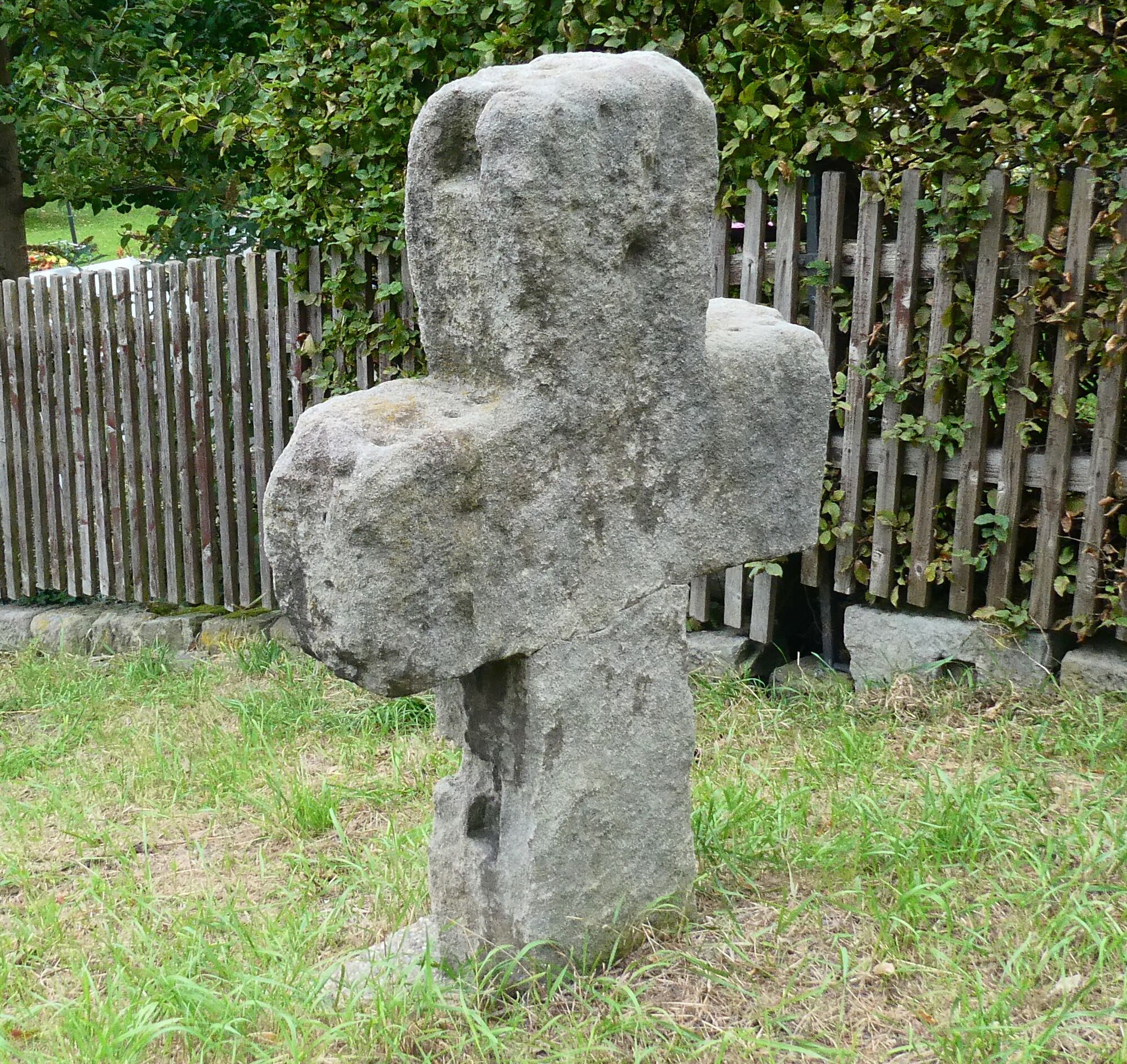
13) Reinholdshain stone cross
Not much is known about this sandstone cross. The square excavations indicate that it was built into a garden retaining wall until 1934. The shaft at the level of the lower arm edges was broken off and later replaced.
Food for thought on the way:
"There is one path in this world that only you can take. Where does it lead? Don't ask, walk it."
Friedrich Nietzsche, philosopher 1844 - 1900
Along the way, one or two things may fall away from us or even break open. Breaks are part of our life stories.
Further route: Continue on the road towards Dippoldiswalde until you reach Oberhäslicher Straße in the industrial estate. Turn right and continue straight ahead. Turn right at Industriering and continue until you reach a car dealership, where you have to turn left. Follow the footpath to Oberhäslich. At the end of the path, turn left and follow the road. After reaching the main road, cross it at the pedestrian lights and turn right until you reach the junction of a hiking trail marked with a green dot (Fiebigstraße). Turn left there and walk to the point where there are several signposts. Later we return to the hiking trail marked with a green dot. Turn left there until you reach the
14) Stone cross with sabre-like weapon
Two carved crossed swords or sabres can be seen. It is assumed that this was a soldier's grave from the 18th century. The stone cross was re-erected with a new base in 2008.
Something to think about on the way: Let me walk slower! Relieve the hurried beating of my heart through the stillness of my soul; let my hasty steps become steadier with a view of the vast expanse of eternity. In the midst of the confusion of the day, give me the peace of the eternal mountains. Release the tension of my nerves and muscles with the gentle music of the singing waters that are alive in my memory. Let me slow down to see the flower, exchange a few words with my friend, pet a dog, read a few lines in a book. Let me slow down and give me the desire to sink my roots deep into the eternal ground so that I may grow upwards to my true destiny.
Prayer from South Africa
Further route: back to the signs, turn left onto the path and at the edge of the forest turn left again onto the Häslicher Randweg until you reach the road, cross it and continue to the right until you reach the signposts, turn left at these and continue straight ahead until you reach the Malterweg, turn right onto this path and you have reached your next pilgrimage destination.
15) The stone knife or knife stone
We see a mutilated stone cross on the Malterweg and near the Alte Rabenauer Straße hiking trail junction. The outline of a knife is carved into the shaft. This is an old mark to atone for a murder or manslaughter. It was erected at the scene of the crime as a reminder. The cross was later used as a wayside pillar. In 1785, the "Stone Knife" is mentioned in the forest sign book.
Food for thought along the way: a knife becomes an instrument of murder. We don't know whether it was an intentional act or an incident of self-defense. Sometimes things are on a knife's edge and go one way or the other? I have to decide whether the outcome is positive or negative.
Further route: from there, stay straight on the Malterweg until you reach the signpost for the boulder cross, this is on the left-hand side, a narrow path (please dismount and walk) leads to the
16) Foundling cross
This sandstone cross lives up to its name. It is not easy to find. It is located not far from the Stone Knife, in the direction of the Einsiedlerstein in forest section 54. It is possibly related to an old pilgrimage route that led westwards to the Altzella monastery near Nossen. The name goes back to the fact that an unknown corpse was once found here after the snow melted.
Something to think about along the way: crosses as gravestones in places where people have died. We come across them on roadsides. And here on an old, often traveled path. A place of final resting place. When was the last time I was in a cemetery? Do I regularly visit my relatives at their final resting place?
Further route: from there back to the Malterweg and left along it to the Einsiedler, where you will find
17) Hermit's Stone and St. Catherine's Chapel
The Einsiedlerstein is a geological natural monument. The neighboring sandstone rocks bear the foundation walls of a small chapel (6 x 4 m) called St. Catherine's Chapel. During the Reformation, the Catholic St. Catherine's Chapel was demolished in 1539. The stone carvings for beams, rabbets and steps indicate the former building. A hermit named Dippold is said to have lived here in ancient times (legend).
Food for thought on the way: Katharina and Dippold lived in seclusion. Their task at the time was to pray for other people in crises and emergency situations. People came to them to share their worries and problems and to get advice and help. Do I have people I can trust who will listen to me openly and honestly? Do I have the worries and needs of others on my mind and in my heart?
Further route: return along the Malterweg and turn right at a seating area onto the forest road to the
18) St. Barbara's Chapel
The chapel is named after the patron saint of miners - St. Barbara. It was built around 1500 and was also looked after by a priest who offered church services and masses. The chapel was destroyed during the Reformation and restored as a ruin in 1881. In the choir, we read the saying "What age bequeaths to us, spare the young!"
The legend of St. Anthony is also associated with St. Barbara's Chapel. It tells of a pious man who lived in a hermitage and is associated with the construction of the chapel. An artistically designed altar is said to have stood in the chapel. There is said to have been a healing spring near the chapel. Names of streets, paths and parcels of land still provide clues to the old days: Klausenweg, Antonsweg and Antonswiesen.
Something to think about on the way: Barbara lived in the 3rd century in what is now Izmir, Turkey. She learned about the Christian faith through her teacher and nanny and was baptized as a teenager. At that time, Christians were persecuted and usually sentenced to death. Barbara even had her father to thank for this fate. - Old and young. How do the generations relate to each other?
Further route: follow the path (now marked with a yellow line) to Oelsa, turn right after reaching the road and take Am Bach before the bridge. At the end, turn left onto the main road and through the village to the
19) Oelsa church
The church was consecrated on 1 Advent 1928. The altar and baptismal font are made of sandstone. The stained glass windows depict the evangelists Luke and Mark, created by the Dresden glass painter Josef Goller. The resurrection painting in the chancel was donated by the Dresden artist Eberhard von der Erde.
For reflection on the way: "Come to me, all you who are weary and burdened, and I will give you rest." (Matthew 11:28) - We find these words of Jesus above the entrance door. What burdens me? What do I want to discard? Who can I go to in order to find open ears and an open heart? What helps me to draw inner strength? - Take time for a moment of silence in the church! You are welcome to fold your hands when you answer the questions for yourself.
Further route: Drive to the end of the village and turn right at the bend to the black pond. Cycle around it until you reach a small bridge. Drive over it and turn right to the signpost. Turn left at Lindenwehrweg and at the end turn right into Forstststraße Weiße Straße, then uphill to Marktsteig, turn left onto this road, which leads to Rabenau. Turn right into Max-Meier-Straße in the new residential area, then turn left into Nordstraße, at the end turn right into Hainsberger Straße as far as house no. 32, where a small road turns off to the left. The road turns into a country lane. There you will find the Rabenauer Höhe with the
20) Confessional monument in Rabenau
The monument was erected on Reformation Day in 1832 and restored in 2017. It stands for freedom of faith and, today, freedom of religion. The Augsburg Imperial and Religious Peace was about the free exercise of religion by Protestant and Catholic believers. The inscriptions on the monument read:
East side: Hail to the founders, thanks to the defenders of Protestant freedom of faith! Freedom of faith!
South side: In grateful remembrance of the third evangel. Confessions-Jubelfeyer on June 25, 26 and 27, 1830
West side: erected on October 31, 1832 - renewed on September 25, 1855
North side: Psalm 126, v. 3 (God has done great things for us; we are glad of it.)
For reflection on the road: Be free in what I believe. Being able to express your opinion freely without offending others. Encounter other religions freely and openly. Time and again, we have to struggle and even fight for this. How important are these values to me?
Further route: straight ahead to the hotel, Galgenberg, Höhenstraße, Hainsberger Straße and turn left at the crossroads into Freitaler Straße; in the center of the village you will find St. Egidien Church, the starting point.
Tak
No special equipment is required.
Coming from Dresden (B170), Freital or Dippoldiswalde, follow the signs to Rabenau. In Rabenau follow the signs to Markt or Bf. Rabenauer Grund.
RVSOE bus line 347, 348 and 376.
Weißeritztalbahn (bicycle transport may be restricted, if in doubt contact SDG by telephone)
Rabenau market (subject to charge)
-inside visits to the churches along the way - some only possible by prior arrangement (St. Egidien Rabenau church, Seifersdorf church, St. Konrad Catholic church in Dippoldiswalde, St. Marien and Laurentius town church in Dippoldiswalde, St. Nikolai church in Dippoldiswalde, Oelsa church)
-Visit to the German Chairmaking Museum in Rabenau(www.deutsches-stuhlbaumuseum.de)
-visit the MiBERZ (Museum of Medieval Mining) and the Dippoldiswalde Tanners' Museum and Gallery
-The route is also easy to cycle in stages. An overnight stay is recommended. Pilgrims are welcome in the "Villa Else" in Oelsa. Further accommodation options can be found here: Host directory Rabenau
Popularne wycieczki w okolicy
-
Trebnitzgrund to enjoy (Glashütte)
średniWędrówka 14,6 km -
Oberbärenburg- Tellkoppe- Ausichtsturm, Deutschland Altenberg im Erzgebirge, Deutschland
światłoWędrówka 8,08 km -
5,0
Winter experience Rabenauer Grund and Rabenauer Höhe
średniWędrówka zimą 7,79 km -
4,0
Rabenauer Grund family tour and adventure trail
światłoWędrówka 4,92 km -
Legend trail and adventure trail "Legendary Mühlberg"
światłoWędrówka 4,84 km -
5,0
Circular hike Malter and Dippoldiswalder Heide
światłoWędrówka 6,77 km -
Panorama trail Talsperre Malter
Wędrówka 5,08 km -
3,0
Blick auf Dresden
światłoWędrówka 13,3 km -
Water, silver, noble crown ... the Ritter Theler Tour!
średniWędrówka 22,6 km -
Freital, Rabenauer Grund, Semmelsteig und König Albert Höhe
średniWędrówka 7,64 km
Wędrówki i tropienie

Nie przegap ofert i inspiracji na następne wakacje
Twój adres e-mail została dodana do listy mailingowej.